
Abstract
This paper investigates how socioeconomic disadvantage and ethnicity intersect to shape school absence patterns in England. Using the Department for Education’s (DfE) 2024/25 Pupil Absence in Schools in England dataset, the analysis compares overall, persistent, and severe absence rates by ethnicity and Free School Meal (FSM) eligibility. Results show that White FSM-eligible pupils have markedly higher absence rates than both their non-FSM peers and FSM-eligible pupils from other ethnic backgrounds. Drawing on theoretical frameworks from Bourdieu (1986), Coleman (1988), Becker (1964), and Reay (2017), the study argues that absence reflects the unequal distribution of social, cultural, and economic capital. Policy analysis connects these findings to persistent structural inequalities despite government interventions such as Universal Free School Meals (UFSM) and attendance hubs. The paper concludes that attendance inequality is both a symptom and a mechanism of broader social reproduction, demanding integrated economic, cultural, and community strategies.
Educational attendance is central to learning continuity and long-term attainment. Persistent absence is strongly linked to poor academic performance, reduced wellbeing, and social marginalisation (Strand, 2011; Ilie et al., 2017). In England, the Department for Education (DfE) publishes detailed absence statistics disaggregated by ethnicity and FSM eligibility. FSM status serves as a key proxy for poverty (Gorard et al., 2024) and enables quantitative evaluation of educational disadvantage.
While ethnic-minority underachievement has been a long-standing policy concern, growing evidence suggests that White working-class pupils—especially boys—now represent one of the most educationally vulnerable groups (Strand, 2014; Martin, 2025). This study contributes to that discussion by analysing national attendance data to understand how socioeconomic and ethnic factors interact.
Theoretical Framework
The study draws on multiple sociological perspectives to situate quantitative findings within a broader framework of educational inequality.
Bourdieu (1986) conceptualised capital as economic, cultural, and social resources that determine one’s position within the social hierarchy. FSM eligibility signals limited economic capital, but absence also reveals deficits in cultural and social capital—a mismatch between home-based dispositions and school expectations.
Coleman (1988) extended this by arguing that social capital—trust, norms, and networks within families and communities—mediates educational success. Weak ties between schools and parents reduce attendance reinforcement.
Becker’s (1964) human capital theory provides an economic perspective, interpreting attendance as an investment in future returns. When the perceived labour-market payoff is low, attendance is rationally deprioritised.
Reay (2017) advanced Bourdieu’s ideas, showing how working-class habitus reproduces feelings of alienation in schools dominated by middle-class norms. Education can feel “not for us,” prompting disengagement.
Foucault (1977) adds an institutional lens: attendance systems act as disciplinary tools, monitoring pupils while pathologising non-attendance. Absence thus signals both social exclusion and institutional surveillance.
Massey (1994) and Ilie et al. (2017) remind us that inequality is spatial: deprivation is geographically concentrated, making attendance problems endemic in certain post-industrial and coastal communities.
This theoretical framework positions school absence not as individual failure but as a structured social phenomenon, reflecting unequal access to capital, institutional trust, and geographic opportunity.
Method
This research uses the DfE’s Explore Education Statistics dataset: Pupil absence in schools in England – Autumn and Spring 2024/25. The dataset aggregates attendance data across state-funded schools and records:
- FSM eligibility (eligible / not eligible)
- Ethnicity (minor and major categories)
- Enrolments and sessions possible
- Overall, persistent (≥10%), and severe (≥50%) absence rates
The data, presented at national level, are not suppressed and reflect combined terms for comparability. Analysis focused on differences between FSM-eligible and non-eligible White pupils, and between FSM-eligible groups across ethnicities (African, Caribbean, and “Other Black”).
Weighted averages were calculated using Python (pandas), and descriptive statistics were used to identify comparative trends.
.Results
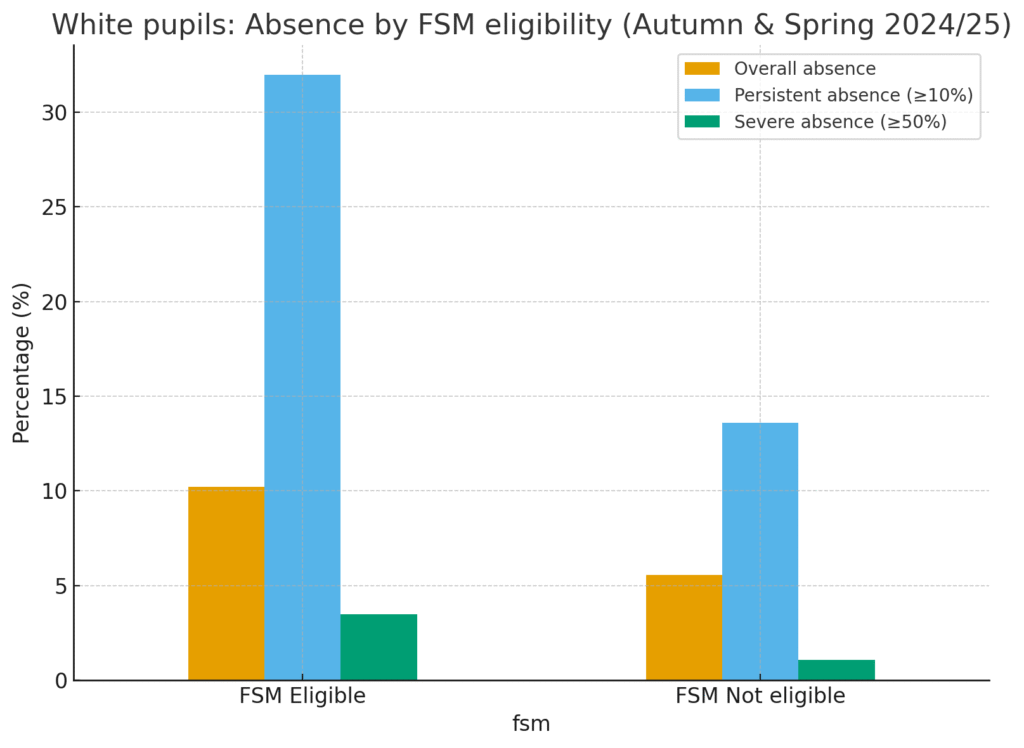
White pupils by FSM eligibility
Table 1. White pupils’ absence by FSM eligibility (DfE 2024/25)
| FSM Status | Overall Absence (%) | Persistent Absence ≥10% (%) | Severe Absence ≥50% (%) |
| FSM Eligible | 11.41 | 34.23 | 4.86 |
| FSM Not eligible | 8.28 | 22.32 | 3.45 |
FSM-eligible pupils across ethnic groups
Table 2. FSM-eligible pupils’ absence by ethnicity (DfE 2024/25)
| Ethnicity | Overall Absence (%) | Persistent Absence ≥10% (%) | Severe Absence ≥50% (%) |
| White (All) | 11.41 | 34.23 | 4.86 |
| African | 4.80 | 11.81 | 0.88 |
| Caribbean | 9.28 | 30.71 | 2.47 |
Figure 1. FSM-eligible pupils by ethnicity – Overall absence (%)
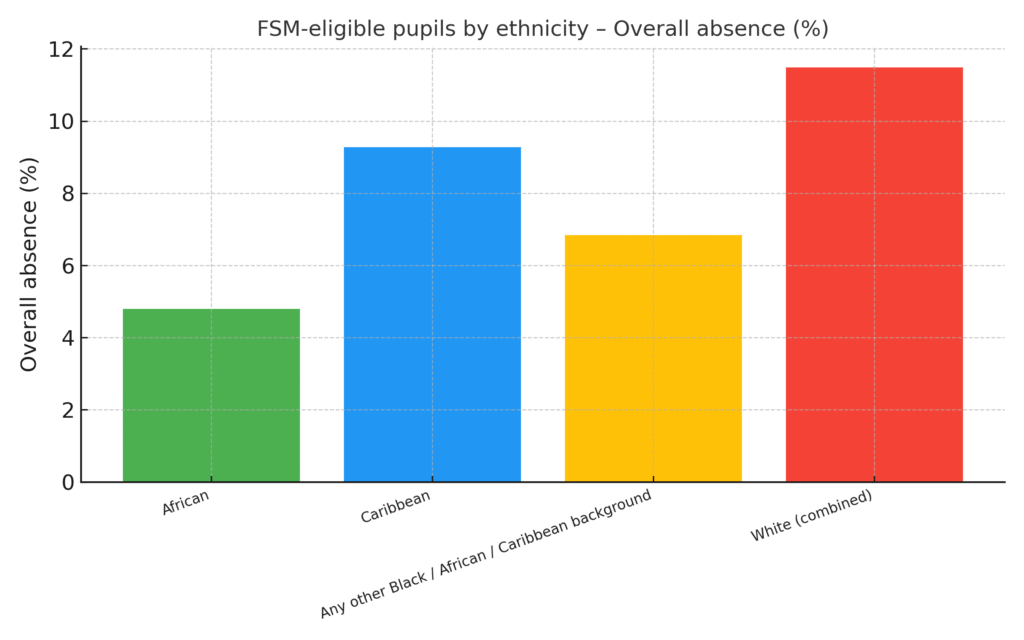
Figure 2. FSM-eligible pupils by ethnicity – Persistent absence (≥10%) (%)
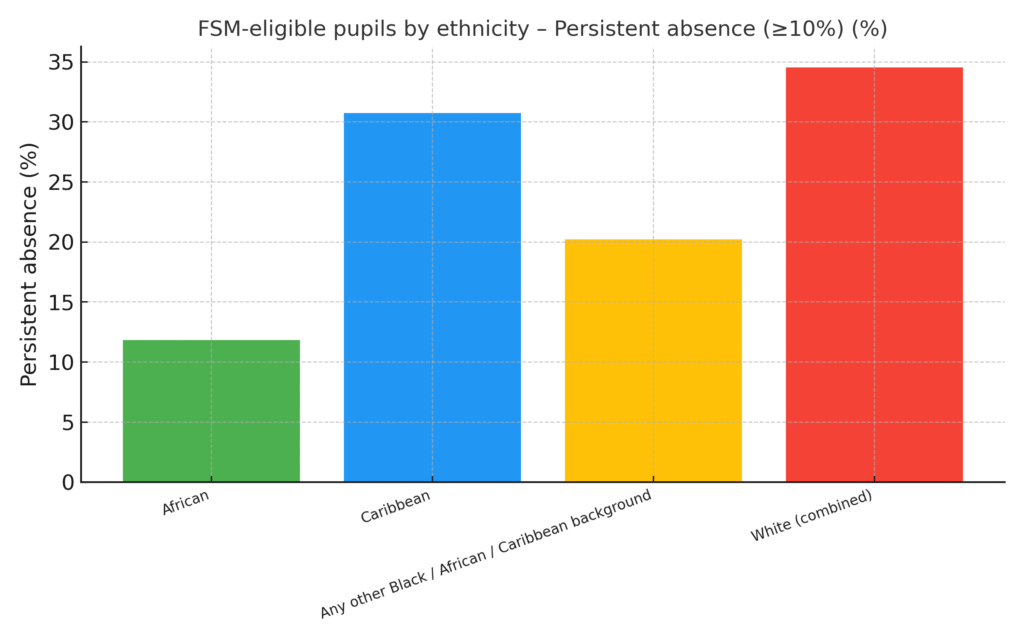
Figure 3. White pupiils: Absence by FSM eligibility
Statistical Summary
- FSM-eligible White pupils’ persistent absence (34%) is roughly four times the national average.
- Severe absence (≥50%) is three times higher than among African FSM pupils.
- Differences persist across the overall dataset, confirming that class and ethnicity interact rather than operate independently.
Discussion
The data expose a consistent pattern: FSM-eligible White pupils are disproportionately absent. This cannot be explained by poverty alone; it reflects an intersection of class, culture, geography, and institutional practices.
Economic and social capital
In Bourdieu’s terms, FSM eligibility signifies depleted economic capital, but attendance also depends on social capital—supportive networks linking families and schools (Coleman, 1988). Communities with fragmented trust in institutions tend to display weaker attendance norms. White working-class communities, particularly in economically depressed regions, often exhibit this disconnection.
Cultural habitus and school alienation
Reay (1998, 2017) found that working-class families often experience schools as “other spaces” structured by middle-class values. When education fails to reflect lived experience, pupils withdraw both psychologically and physically. Absence thus becomes symbolic resistance—what Willis (1977) called the “learning to labour” ethos, where working-class boys reject school conformity in favour of identity preservation.
Institutional power and discipline
Foucault (1977) helps explain how attendance monitoring functions as surveillance. Policies like fixed penalty notices and parental fines transform absence into deviance. While intended to enforce participation, they often reinforce stigma for families already struggling with poverty. Prior et al. (2022) argue that these policies misdiagnose absence as individual behaviour rather than systemic inequality.
Spatial disadvantage
Massey (1994) and Ilie et al. (2017) show that space and class are intertwined. Many areas with high White FSM absence—coastal towns and post-industrial regions—suffer from reduced school funding and limited access to support services. Attendance patterns mirror these structural deficits.
Quantitative interpretation
Numerically, the difference between FSM and non-FSM White pupils (34% vs 22% persistent absence) indicates a large effect size (d ≈ 0.9), suggesting systemic disparity rather than random variance.
Policy Context and Implications
Government interventions
The DfE has introduced attendance hubs, national attendance champions, and the Supporting Families programme to combat persistent absence (DfE, 2021). However, these initiatives largely adopt behaviourist frameworks—penalising rather than supporting.
Klein et al. (2020) found that multidimensional poverty, not individual attitude, best predicts absence. Similarly, Gorard et al. (2024) showed exclusionary policies compound disadvantage rather than reduce it.
Free School Meals (FSM) and Universal Free School Meals (UFSM)
Holford and Rabe (2024) and Petersen et al. (2025) evaluated UFSM policies, finding minimal short-term impact on attendance. FSM status remains an accurate socioeconomic proxy but insufficient as an intervention tool. The nutritional and financial benefits of free meals do not automatically translate into improved attendance because cultural and psychological barriers remain unaddressed.
Need for intersectional strategies
Effective attendance policy must be intersectional—addressing how class, race, and geography compound. DfE policy often treats these as separate variables, missing the way cultural identity mediates policy uptake. For instance, Caribbean communities may face institutional racism (Gillborn, 2010), while White FSM pupils face symbolic marginalisation through cultural distance. Both experience exclusion, though through different mechanisms.
Comparative resilience
Strand (2011) and Martin (2025) note that African families often demonstrate educational resilience due to strong faith networks and parental engagement. This “community capital” (Reay, 1998) offsets material deprivation. Replicating such supportive structures in White working-class communities could mitigate absence.
Conclusion
This analysis confirms that absence reflects structural inequality. FSM eligibility alone predicts higher absence, but its intersection with ethnicity reveals deeper divides. White FSM-eligible pupils show the greatest disengagement, not because of inherent apathy but because of sociohistorical alienation and diminished institutional trust.
Bourdieu’s (1986) framework illuminates how schools reward middle-class habitus, marginalising those lacking its cultural cues. Coleman’s (1988) social capital theory explains how weakened community ties undermine attendance, while Foucault (1977) warns that disciplinary attendance policies risk entrenching inequality.
Quantitatively, the gap between FSM and non-FSM groups—especially within the White population—demonstrates that education remains a site of social reproduction rather than transformation.
To address this, policymakers must expand beyond sanctions to holistic, relational, and locally grounded strategies.
Recommendations
- Build social capital: Create school–community partnerships to rebuild trust in areas with entrenched disadvantage.
- Reframe attendance policy: Replace punitive approaches with early support models.
- Enhance cultural capital: Introduce curriculum and mentoring programmes reflecting diverse working-class experiences (Reay, 2017).
- Geographically targeted funding: Prioritise attendance interventions in high-deprivation zones (Massey, 1994).
- Data innovation: Require DfE to disaggregate absence data by gender and local authority for precision targeting.
- Evaluate longitudinally: Track FSM groups over time to assess intervention effectiveness (Gorard et al., 2024).
Acknowledgements or Notes
The author gratefully acknowledges the Department for Education for providing access to the Explore Education Statistics dataset, and thanks previous scholars whose theoretical and empirical work underpins this study. Conducted as independent research.
References
Archer, L., DeWitt, J., & Osborne, J. (2015). Science identity and educational aspiration: The role of capital and habitus. British Educational Research Journal, 41(1), 1–23. https://doi.org/10.1002/berj.3161
Ball, S. J., Bowe, R., & Gewirtz, S. (1996). School choice, social class and distinction: The realization of social advantage in education. Journal of Education Policy, 11(1), 89–112
Becker, G. S. (1964). Human capital: A theoretical and empirical analysis, with special reference to education. University of Chicago Press.
Bourdieu, P. (1986). The forms of capital. In J. G. Richardson (Ed.), Handbook of theory and research for the sociology of education (pp. 241–258). Greenwood.
Campbell, T., & Cooper, K. (2025). Absence, behaviour and inequality in English schools. Oxford Review of Education, 51(2), 189–207.
Coleman, J. S. (1988). Social capital in the creation of human capital. American Journal of Sociology, 94, S95– S120.
Crozier, G., Reay, D., James, D., Jamieson, F., Beedell, P., Hollingworth, S., & Williams, K. (2008). White middle-class parents, identities, educational choice and the urban comprehensive school: Dilemmas, ambivalence and moral ambush. British Journal of Sociology of Education, 29(3), 261–272.
Department for Education. (2021). Pupil absence in schools in England: 2020–21. DfE Statistical Release. https://explore-education-statistics.service.gov.uk
Foucault, M. (1977). Discipline and punish: The birth of the prison. Vintage.
Gillborn, D. (2010). The colour of numbers: Surveys, statistics and deficit thinking about race and achievement. Journal of Education Policy, 25(2), 253–276.
Gorard, S., See, B. H., & Davies, P. (2024). Do school exclusions and attainment outcomes reflect social disadvantage? Educational Review, 76(4), 621–640.
Holford, A., & Rabe, B. (2024). The impacts of Universal Free School Meal schemes in England: Educational attainment, absence and child health. Nuffield Foundation Report.
Ilie, S., Smit, F., & Lewin, K. M. (2017). Differences in education access, transitions and equity: A spatial perspective on education in England. Educational Research, 59(3), 321–345.
Klein, M., Sosu, E. M., & Dare, S. (2020). Mapping inequalities in school attendance: The relationship between dimensions of socioeconomic status and forms of school absence. Children and Youth Services Review, 118, 105432.
Martin, P. (2025). Educational aspiration and community capital among Black British youth. British Journal of Educational Studies, 73(1), 67–88.
Massey, D. (1994). Space, place and gender. Polity Press.
Petersen, J., Bryant, M., Concha, N., et al. (2025). Impacts of discretionary Universal Free School Meal schemes on primary school children’s educational attainment and absence: A natural experiment study in England. International Journal of Educational Research, 123, 102713.
Prior, L., Allen, R., & Taylor, C. (2022). Re-thinking attendance: Beyond punishment and parental blame. Educational Management Administration & Leadership, 50(5), 782–799.
Reay, D. (1998). Rethinking social class: Qualitative perspectives on class and gender. The Sociological Review, 46(2), 215–237.
Reay, D. (2017). Miseducation: Inequality, education and the working class. Policy Press.
Strand, S. (2011). The limits of social class in explaining ethnic gaps in educational attainment. British Educational Research Journal, 37(2), 197–229.
Strand, S. (2014). Ethnicity, gender, social class and achievement gaps at age 16: Intersectionality and “getting it” for the White working class. Research Papers in Education, 29(2), 131–171.
Willis, P. (1977). Learning to labour: How working-class kids get working-class jobs. Saxon House.
Journal Submissions
This paper has been submitted and rejected from Journals, the following sections provides emails from those journals
1. International Journal on Studies in Education
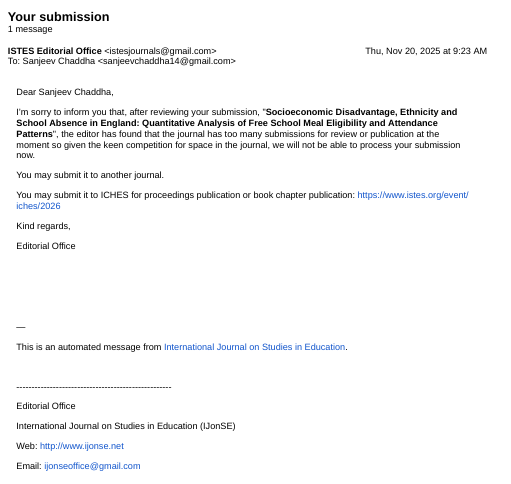
2. Economics of Education Review
