
This post outlines various energy requirements a domestic housing estate would have and provides collective solutions together with high level costs. The intension is to build “off grid” proposal for a housing developments in Nigeria. Where possible existing mature technologies have been selected to meet energy needs.
Energy Demand/Supply
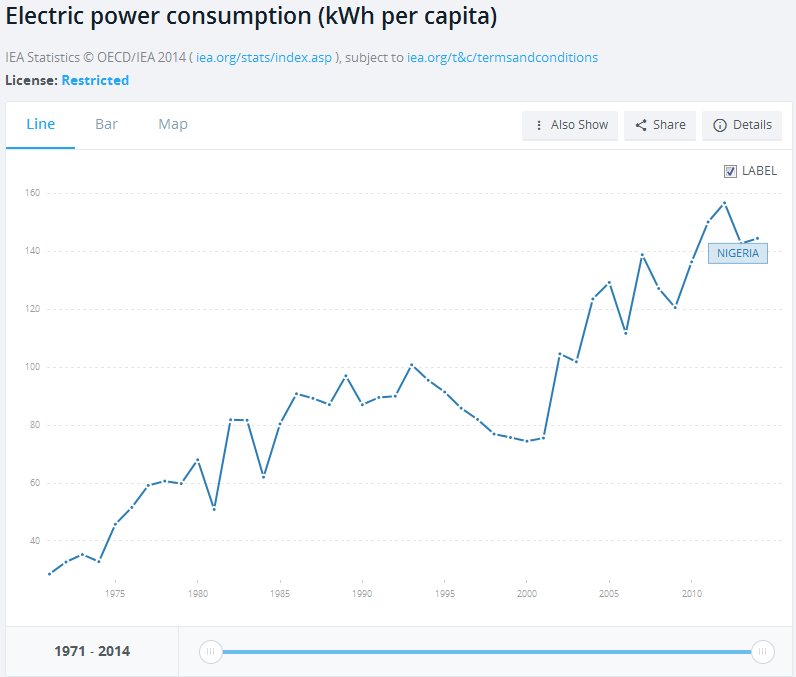
Year on year energy demand in Nigeria has grown from circa 40kWh per capita in 1975 to circa 150 in 2014. The national grid (Transmission Company of Nigeria) announced that power generation capacity dropped. [1]. Nigerias energy demand has risen and nationally produced energy has not kept up.
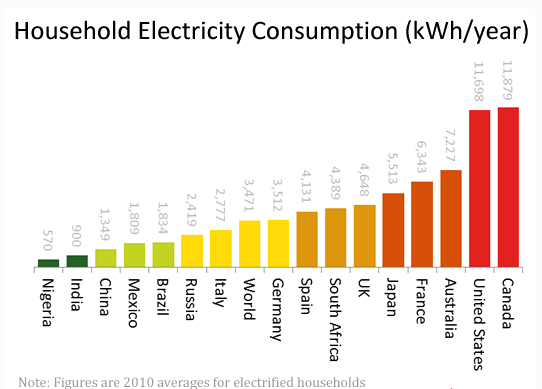
Nigerians are exceptionally frugal with their energy use, they on average use less that BRIC countries (i.e. Brazil, India, Russia, China), however as the country continues to prosper energy demand will continue to rise.
Main energy considerations for a housing development
A housing development would have energy requirements to serve several cost functions
- Heating water for washing
- Cooling houses / air conditioning
- Cooking / lighting
Heating water for washing
Large scale commercial solar powered hot water systems can be re-purposed to provide hot water to a housing estate. Nigeria has on average 1885 hours of sunlight per year[4] therefore between 3 and 5 metres squared of solar collectors would be required per house in the estate, this would result in constant hot water for heating the home without the need for an external power source. The Bosch System[5] allows for up to 50 flat plates in a “single field”, together with large thermal stores and solar filling pump[6] so between 15 and 25 properties could be serviced from a single system.
Cooling houses / air conditioning
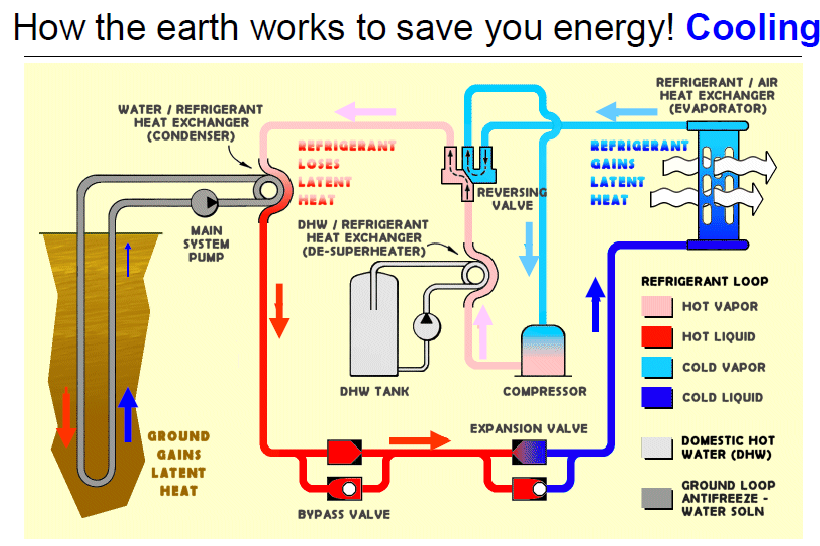
Ground source heat pumps can be used to heat buildings by transferring heat from the ground in winter: Ground Source Heating. They can equally be used in commercial buildings to transfer heat back into the ground in summer: Ground Source Cooling. In this instance we are proposing to use Ground Source Cooling to provide air conditioning (air cooling) to houses within an estate.
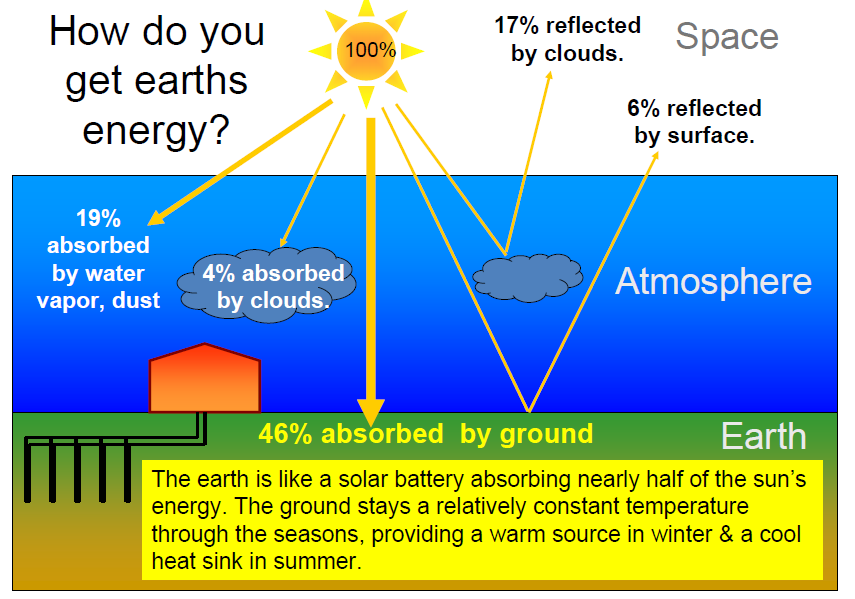
Cooling-In the summer expels heat from the building to the cooler earth via the loop system. This heat exchange process is natural and highly efficient way to create a comfortable climate in the building. This process will cool houses to circa 21 degrees Celsius (70 degrees F). The same system could be used to heat up houses in the winter to 21.
Cooking / lighting
Solar
As previously stated Nigeria has on average 1885 hours of sunlight per year[8], it is possible to harvest this energy with solar cells. Two complementary solutions are recommended
Photovoltaic Solar Cells – for Small Household Appliances
A mixture of ground mounted and roof mounted solar cells could be used to provide energy for a housing development. Commercial “sized” solar farms are readily available to supply small household appliances which are designed to accept direct current (DC) e.g. broad routers, LED lights, phone chargers.
Assuming each home requires 20kWh per month[9], i.e. 1 kWh per day, a system sized for 30 houses would be 20 kWh, costing circa £30k[10]. For energy storage a battery system would also be required, costing circa £55k[11]. This type of system would allow a housing estate to have independent power and have stored energy for one day.
Solar Reflector Heating up Oil to generate electricity – for Large Household Appliances
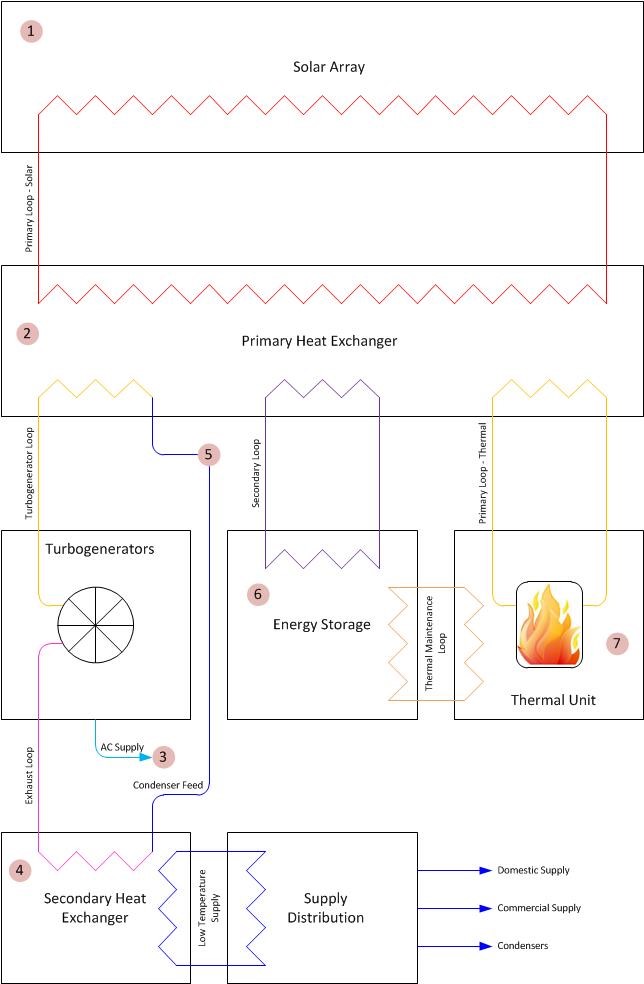
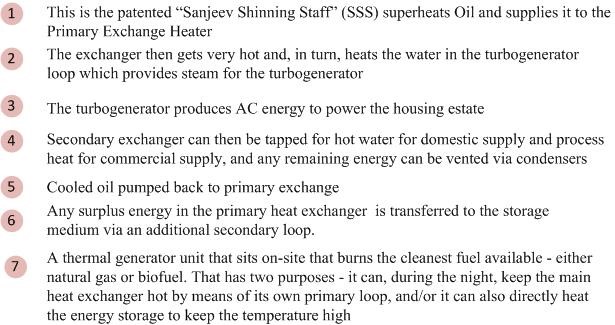
Separate alternating current (AC) mains feed for higher power appliances like TV, stereo, fridge, cooker, etc. This system would be based on using mirrors to focus solar energy on pipes of oil, the oil would super heat and drive turbines providing AC current, any excess heat generated could be used to produce electricity during “low light” periods e.g. nights. This largely removes the need for large expensive batteries for most power needs. The diagram below illustrates the system.
Wind
Dependent on the site, it may be possible to supplement Solar energy with wind power. The site would need to on the tops of hills in upland areas or on tall towers, in principle exposed areas. Assuming the housing estate is located in an appropriate location, wind power can provide significant energy. A 10kW wind turbine would cost circa £50k[12].
Conclusion
It is possible to produce most energy to run a housing development, the solutions outlined within this document could be retrofitted in an existing development or installed in a new development. The costs incurred would be offset by lower energy bills and by reduced reliance on the national grid.
[1] http://dailypost.ng/2017/01/17/power-outage-cripples-commercial-activities-nigeria-capital-abuja/
[2] Source – http://data.worldbank.org/indicator/EG.USE.ELEC.KH.PC?end=2014&locations=NG&start=1971&view=chart
[3] Source – http://shrinkthatfootprint.com/average-household-electricity-consumption
[4] Source – http://www.lagos.climatemps.com/sunlight.php
[5] Reference – https://www.bosch-industrial.co.uk/files/Solar_Overview_Brochure_web_res_UK.pdf page 6
[6] Reference – https://www.bosch-industrial.co.uk/files/Solar_Overview_Brochure_web_res_UK.pdf page 17
[7] Reference —http://www.sonicdrilling.com/geothermal_site/PowerPoint/How%20a%20Ground%20Source%20Heat%20Pump%20Works%20for%20Commercial%20Buildings.pdf page 9
[8] Source – http://www.lagos.climatemps.com/sunlight.php
[9] Approximately the same energy requirements as a Russian household
[10] Source – http://www.theecoexperts.co.uk/commercial-solar-panel-systems
[11] Source – https://www.wholesalesolar.com/solar-battery-banks
[12] Source – http://bergey.com/wind-school/residential-wind-energy-systems
Like!! I blog frequently and I really thank you for your content. The article has truly peaked my interest.